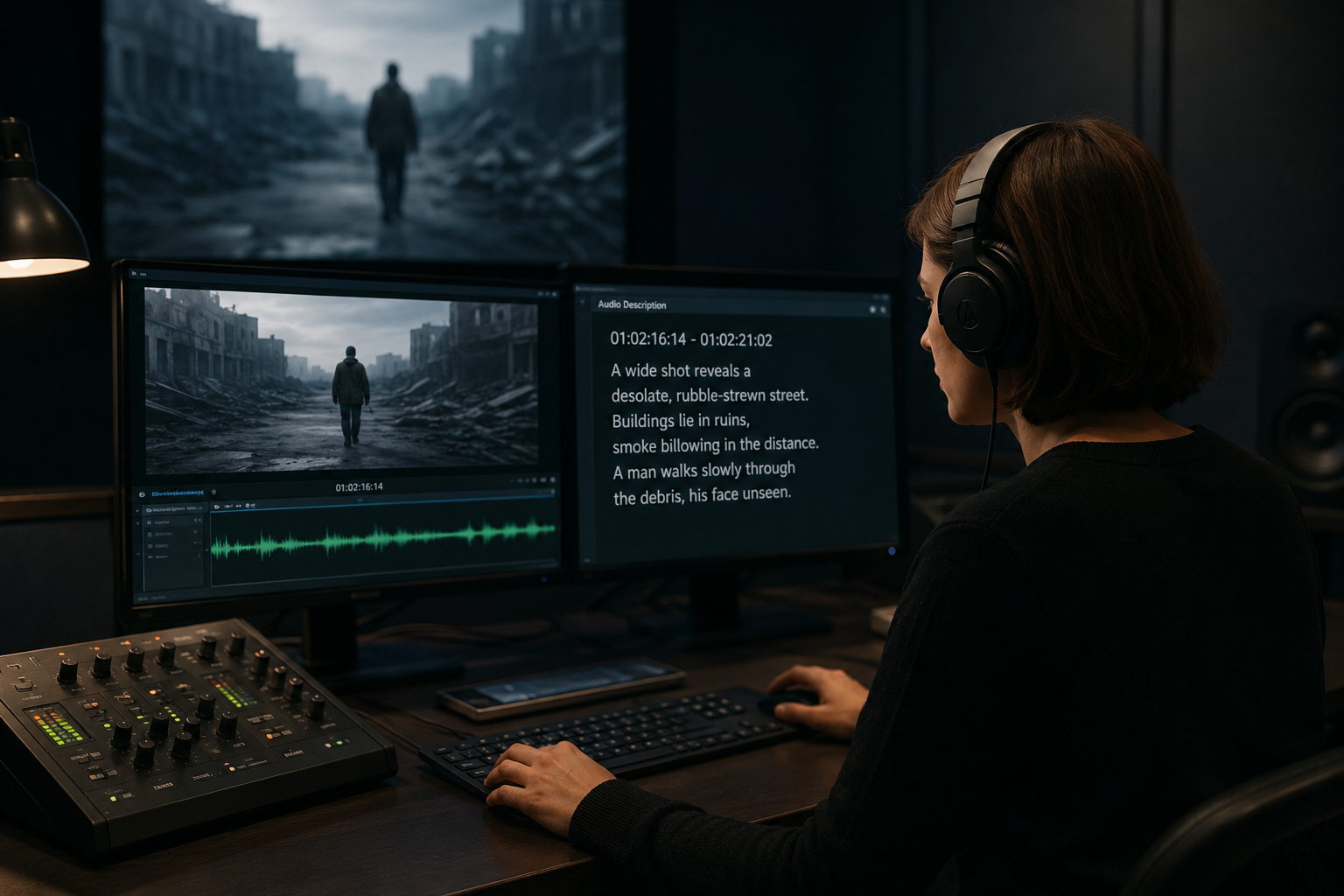
If you work in audio description, you have probably heard some version of the same claim: AI is coming for your job. The reality is more nuanced — and, for working describers, considerably more interesting.
AI is changing the audio description workflow. But the change is not substitution. It is compression. The parts of the job that took four hours now take forty minutes. The parts that required a storyteller still require a storyteller.
Here is an honest account of what shifts, and what does not.
The Traditional Audio Description Workflow
The classic AD workflow for a 24-minute television episode looks roughly like this: watch the episode in full to understand tone and character dynamics, then go back and identify every window — the gaps between dialogue lines where description can live. Write a script that fits those windows without overlapping speech. Time each description to the cut. Record with a narrator or send to a voice studio. Review the mix. Deliver.
End to end, that process takes an experienced describer three to five hours per hour of finished content. For a streaming back-catalogue of any real size, the arithmetic becomes brutal quickly.
Where AI Changes the Equation
Modern AI audio description tools — built on multimodal models that understand both the visual content and the dialogue track — can collapse the first three steps of that workflow into a few minutes.
The AI watches the video. It detects dialogue windows automatically, so you are not hunting for gaps manually. It writes a first-draft description for every window, calibrated to the programme’s tone and pacing. It flags every clip where the description runs close to a dialogue line. By the time you open the editor, a 24-minute episode is already covered — scene by scene, timed to the cut.
What you receive is not a finished product. It is a starting point that is 80 per cent of the way there. Your job is the remaining 20 per cent: the clips that need a storyteller’s judgment.
What AI Does Well
Establishing shots and transitions. Wide exterior. Empty corridor. Clock ticking on a mantlepiece. These descriptions are formulaic by design — they orient the listener without interpretation. AI handles them reliably and consistently.
Scene-to-scene continuity. A model trained on a whole episode can maintain character naming conventions and spatial references across the runtime in a way that is genuinely difficult to do manually across a long session.
Timing. Fitting a description to a specific window — no shorter than it needs to be, no longer than the silence allows — is a constraint satisfaction problem that AI solves quickly and accurately.
Volume. Batch processing means that the first draft of a ten-episode series is ready before you would have finished episode two by hand.
What Still Needs a Human
This is the part that matters most, and it is not a short list.
Emotional weight. AI can describe what is visible — a character’s posture, the direction of their gaze. It does not always understand what that means in context. A character turning away from the camera at the end of a scene might be leaving. Or grieving. Or hiding something. A good describer knows which, and writes accordingly.
Ambiguity. Some shots are deliberately unresolved. A closed door. A reaction shot with no clear referent. Describing ambiguity accurately — without over-explaining or under-serving — is a craft judgement.
Character voice. The difference between a description that is technically correct and one that is narratively right is often a single word choice. That instinct is trained and human.
Compliance edge cases. AD standards for broadcast, streaming, and theatrical release have specific requirements around character identification, time references, and on-screen text. An experienced describer knows the relevant guidelines for each delivery format; an AI does not always apply them consistently without review.
The HITL Model: Human in the Loop
The workflow model that makes AI audio description production-ready is called Human in the Loop — HITL. Every clip generated by the AI passes through a human review before it ships.
In practice, this means the describer sits in an editor rather than a word processor. Clips are presented sequentially. You approve the ones that are right, edit the ones that are close, and rewrite the ones that are not. You can regenerate any clip with a written direction — more cinematic, shorter, mention the dust on the lens — and the model produces a new take immediately.
Every decision you make is logged to an audit trail. That trail is the compliance record: it shows a broadcaster or regulator exactly who reviewed each clip, when, and what they changed. For EAA 2030, ADA, and WCAG sign-off, that documentation is not optional.
What the Workflow Looks Like in Practice
Before AI audio description tools: a 24-minute episode takes three to four hours. Most of that time is spent on tasks that do not require creative judgment — identifying windows, writing establishing shots, timing clips manually.
With an AI-assisted workflow: the same episode is reviewable in 25 to 40 minutes. The AI handles the structural work. The describer handles the craft. The output quality is the same or better, because the describer’s attention is not depleted by repetitive tasks before they reach the clips that actually matter.
For a freelance describer, that means more projects, not fewer. For a studio, it means back-catalogue compliance at a scale that was previously impossible to staff.
What This Means for Audio Description as a Profession
The skills that make a great audio describer — narrative instinct, economy of language, understanding of visual grammar — are not going away. If anything, they become more valuable, because they are applied more precisely.
What changes is the economics of the entry-level work. Formulaic first-draft description is already being automated. The describers who thrive in this environment will be those who position themselves as reviewers, editors, and quality leads — not transcriptionists of visual information.
The parallel is editing in publishing. Word processors did not replace editors. They eliminated the typing pool and gave editors more time to edit.
A Note on Choosing Your Tools
Not all AI audio description software is built the same way. The questions worth asking before adopting any tool are: does it understand visual context, or just generate text? Does it respect dialogue timing automatically, or does it require manual adjustment? Does it produce a structured audit trail for compliance sign-off? And does it put a human — you — in control of every clip before delivery?
The answer to that last question is the most important one. A tool that ships AI output without human review is not a production tool. It is a liability.
The tools worth using are the ones that make your judgment faster to apply — not the ones that try to replace it.