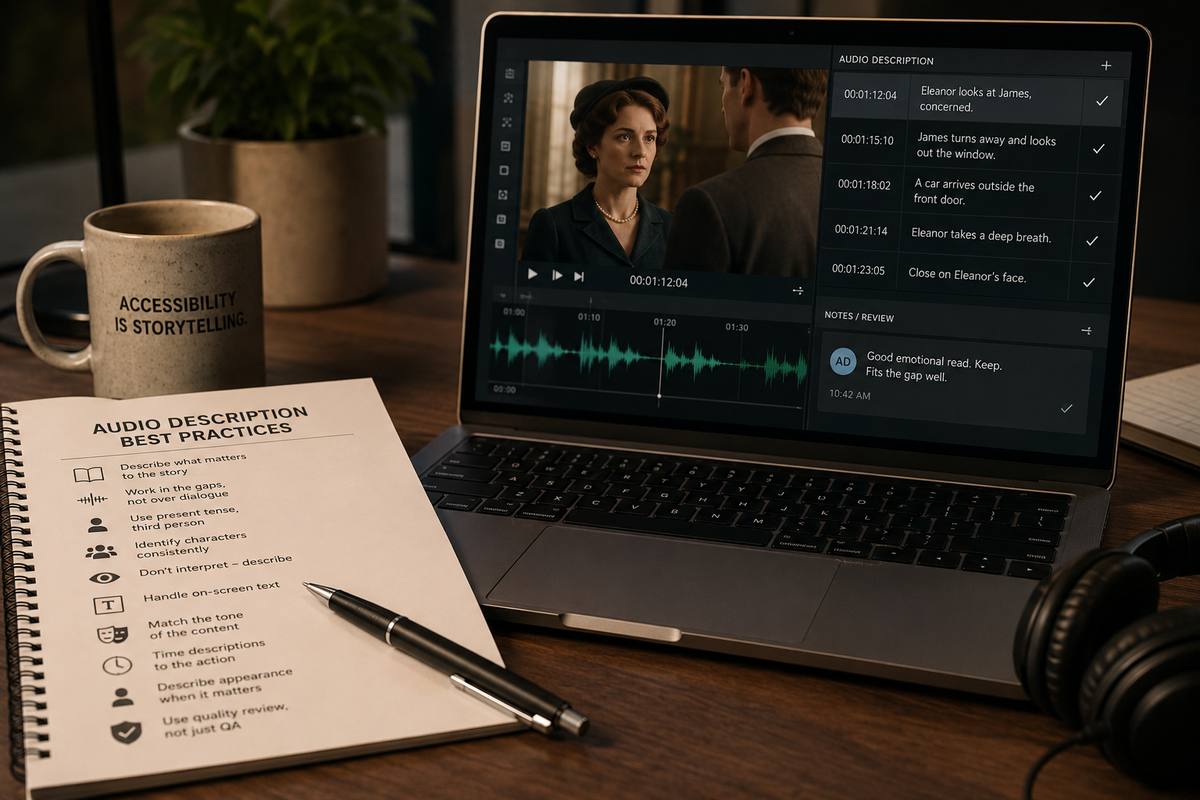
Audio Description Best Practices: How to Write AD That Doesn’t Miss the Story
Audio description is a craft. Done well, it gives blind and low-vision viewers the same narrative experience as sighted ones — without drawing attention to itself. Done poorly, it either buries the story in irrelevant visual detail or leaves critical plot information undescribed.
These best practices are drawn from the major industry standards — ITC Guidance on Standards for Audio Description, ADLAB PRO, the Audio Description Coalition Standards and Guidelines, and the Netflix Timed Text Style Guide — with notes on how they apply in an AI-assisted production workflow.
Principle 1: Describe What Matters to the Story
The most common mistake in audio description — especially AI-generated AD — is describing everything visible rather than what matters. A good describer is a storyteller, not a camera operator.
Ask for each shot: Would a blind viewer miss something plot-relevant or emotionally significant if this went undescribed? If no, skip it.
Examples:
- ❌ “A man in a blue shirt sits at a wooden table with a glass of water to his right.”
- ✅ “Marcus reads the letter, his hands trembling.”
The shirt colour is irrelevant unless it’s been established as a character signifier. The trembling hands are crucial — they convey emotional state that dialogue may not express.
Principle 2: Work in the Gaps, Not Over Dialogue
Audio description must fit within the natural pauses between dialogue. Talking over dialogue is the cardinal sin of AD — it forces the viewer to choose between understanding what’s said and understanding what’s shown.
Practical implications:
- Map all dialogue precisely before writing AD script
- Write to fit the available gap — a 2-second gap needs a short sentence, not a paragraph
- Accept that some visual information must be omitted when gaps are too short
- Use extended AD (pausing video to describe) sparingly and only for truly critical information in dialogue-dense sequences
Principle 3: Use Present Tense, Third Person
AD describes action as it happens, in real time, as if the narrator is watching alongside the viewer.
- Present tense: “She reaches for the gun” not “She reached for the gun”
- Third person: Describe characters by name or role — never in second person (“you see…”)
- Active voice: “The explosion throws him back” not “He is thrown back by the explosion”
Present tense and active voice keep the pace of description aligned with the pace of the film.
Principle 4: Identify Characters Consistently
Consistency in character naming is critical for a blind viewer who has built a mental model of the cast.
Rules:
- Use a character’s name as soon as it is established in the audio (dialogue, on-screen text)
- Before a name is established, describe by appearance: “a tall woman in a red coat”
- Once named, always use the same name — don’t alternate between “Marcus”, “the man”, “he”
- For unnamed characters, establish a consistent identifier: “the detective”, “the suspect”
Principle 5: Don’t Interpret — Describe
AD should convey what is visible, not what the describer infers. The viewer has the right to draw their own conclusions.
- ❌ “She smiles insincerely.” (interpretation)
- ✅ “She smiles, but her eyes are hard.”
- ❌ “He is clearly lying.”
- ✅ “He looks away and adjusts his collar.”
The second versions provide the same visual information while leaving interpretation to the viewer.
Principle 6: Handle On-Screen Text
On-screen text — titles, subtitles, captions, signs, news tickers — must be read in the AD if they are not already included in the main audio and are relevant to understanding the content.
Priority order:
- Location cards and time stamps (“Paris, 1943”)
- Character name introductions
- Plot-relevant signs or messages
- Credits only if significant (director, key cast)
Minor background text (street signs, product labels) should be omitted unless plot-relevant.
Principle 7: Match the Tone of the Content
AD style should reflect the genre and tone of the content being described.
- Thriller/horror: Short, punchy sentences. Urgent rhythm.
- Drama: More descriptive, emotional cues included.
- Comedy: Economy of language; don’t over-explain visual gags (timing is part of the joke).
- Documentary: More factual, can include more contextual detail.
- Children’s content: Simpler vocabulary; warmer tone; more colour and character description.
A flat, neutral tone applied uniformly across all content produces technically correct but experientially poor AD.
Principle 8: Time Descriptions to the Action
AD descriptions should arrive just before or as the action occurs, not after. If a character picks up a weapon, the description should precede or accompany the action — not follow it after the next line of dialogue has begun.
This requires precise timing work in the AD editor. AI platforms with gap-aware TTS scheduling handle this automatically; in manual production it requires careful attention to the mix.
Principle 9: Describe Appearance When It Matters
Character appearance descriptions should be:
- Introduced early — on first significant appearance, before plot gets underway
- Purposeful — include features relevant to plot or character (not exhaustive physical inventories)
- Inclusive — describe race, ethnicity, and disability when visible and relevant, using neutral, person-first language
On describing race: The current industry consensus (reflected in Netflix and BBC guidelines) is that race and ethnicity should be described when visible, as they are part of the visual narrative. Omitting them creates an unintentional “default to white” assumption.
Principle 10: Use Quality Review, Not Just QA
Technical quality assurance (checking that AD is present, timed, and formatted correctly) is necessary but not sufficient. Quality review means a blind or low-vision reviewer watches the content with AD and assesses:
- Does the AD allow them to follow the plot without the picture?
- Are there moments of confusion where visual information was missing?
- Does the AD feel natural and non-distracting?
AI-generated AD has improved dramatically but still benefits from this kind of qualitative review. Synchrogen’s editor workflow is designed to support exactly this — the AI provides a complete first draft that human reviewers can refine.
A Checklist for Audio Description Review
- [ ] All plot-relevant visual information described
- [ ] No descriptions that overlap dialogue
- [ ] Present tense, active voice throughout
- [ ] Characters named consistently from first introduction
- [ ] No interpretive language — description only
- [ ] On-screen text included where relevant
- [ ] Tone matches genre
- [ ] Appearance descriptions present for key characters
- [ ] Tested with audio-only playback by a reviewer
Conclusion
Audio description is a craft with real standards and real stakes. Blind and low-vision viewers depend on it to access the same cultural experiences as their sighted peers. Technical compliance — having an AD track that a WCAG auditor can check — is only the beginning. The goal is description that gives every viewer an equal experience of the story.
AI tools can now produce a broadcast-quality first draft in minutes. The professional’s job is to ensure that draft tells the story the way it deserves to be told.