The Accessibility Gap That AI Actually Helps Close
Right now, 90% of streaming video content has zero audio description. Not because platforms don't care about accessibility—but because the economics don't work. A professional describer spends 6-10 hours per hour of finished content. At that rate, closing the gap for an entire catalog isn't viable. The math just breaks.
Audio description sits in a strange position in the accessibility landscape. Captions are well-served—dozens of tools automate them adequately. Sign language interpretation has specialized solutions. Dubbing and localization workflows are mature. But audio description? Almost nobody builds for it at scale. The work is too slow, too expensive, and requires too much specialized judgment to automate completely.
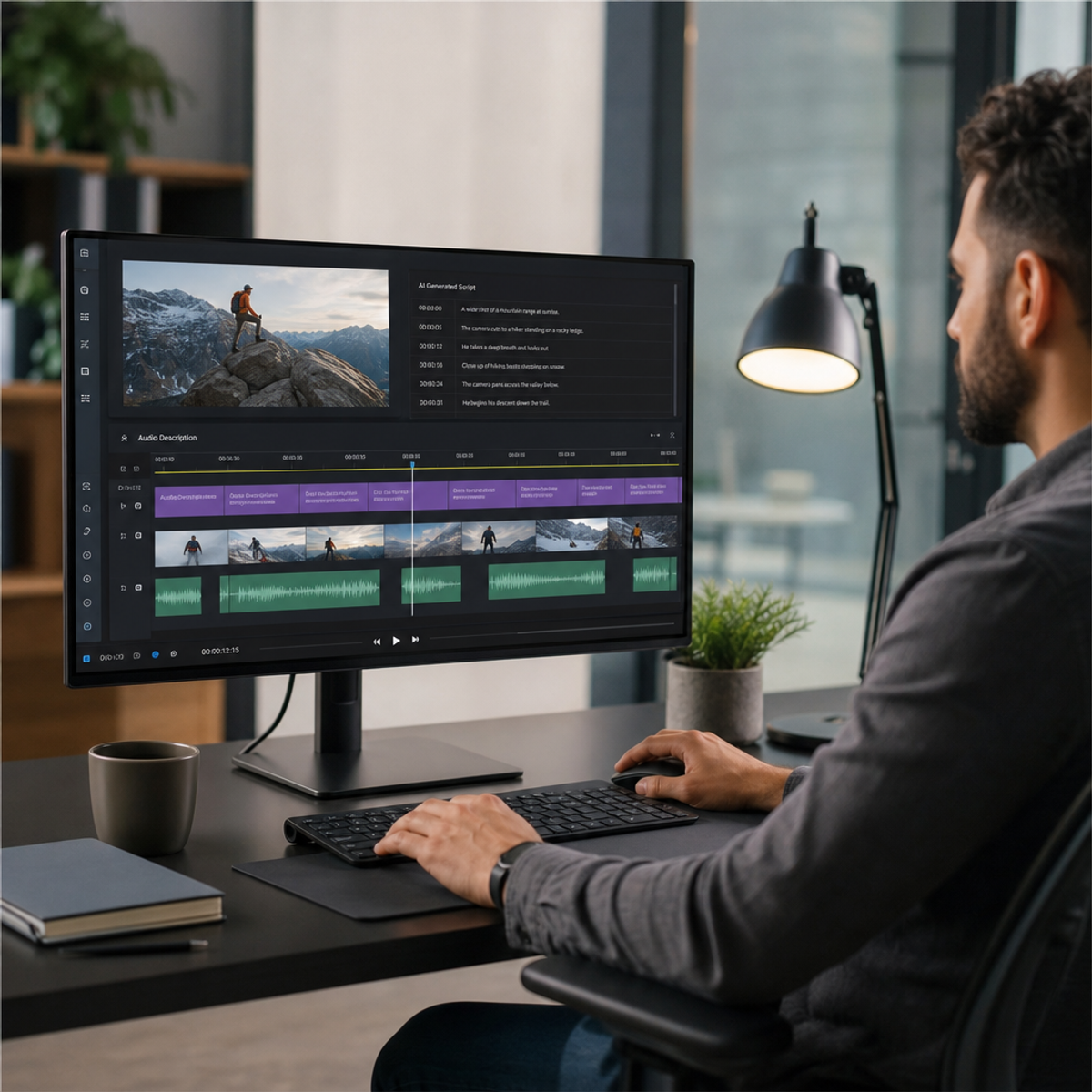
That's exactly where augmentation changes the equation. AI can handle the mechanical parts—detecting where descriptions fit in the dialogue gaps, drafting a first-pass script based on visual analysis, generating synthesized narration, syncing everything to the timeline. What used to take a studio, a voice actor, and a week of editing now gets reduced to a 20-minute human review and refinement job.
This isn't about eliminating describers. It's about letting one describer do the work that used to need three. The craft stays intact—the judgment about what matters, the editorial decisions about tone and context. The busywork disappears. That shift makes it economically feasible to describe the 90% of content that currently gets ignored.
Why Augmentation Works Better Than Full Automation for Audio Description
A model can guess what's on screen. It can't judge what a blind viewer needs to know about it. That distinction matters—and it's why full automation fails for audio description even when it works fine for captions.
Captions are transcription. The words are already there. Audio description is editorial. A describer watches a scene and decides: Does the viewer need to know the character is wearing a wedding ring? Does the color of the walls matter? Is this glance meaningful or just blocking? Those decisions require understanding narrative weight, genre conventions, and audience expectations.
Think of it like AI code agents. A developer doesn't disappear when GitHub Copilot suggests a function—they become 3x more productive. Same dynamic here. Let AI draft the mechanical description of who's in the frame and what objects are visible. Let the human describer decide which details support the story and which ones distract from it.
Professional audio describers had a similar take when we talked to them about this approach. They emphasized the importance of editorial judgment, pacing decisions, and understanding what the director wants the audience to focus on. They don't want to stop being describers. They need to stop doing the mechanical parts—timing cues, drafting boilerplate scene-setting, syncing to the timeline. So that's what we automate.
Better 80% quality for everything than 100% quality for 10%. Right now, most content accessibility sits at 0% because perfect is too expensive. Augmentation makes good enough economically viable.
How Hybrid Workflows Change the Economics of Content Accessibility
Here's the thing: accessibility isn't just a moral requirement—it's also a resource allocation problem. Production teams have compliance deadlines, massive backlogs, and constrained budgets. Telling them to just hire more describers doesn't solve the problem when the cost per hour of content exceeds what they can justify.
Hybrid workflows shift the cost structure entirely. Instead of paying studio rates for every hour of described content, you're paying for human review time. The AI handles scene detection, script generation, voice synthesis, and timeline synchronization—the parts that used to consume 80% of the budget. The describer focuses on the 20% that requires craft: refining the script for narrative clarity, adjusting timing for emotional beats, ensuring the description serves the story.
That's a 20-minute edit instead of a 3-hour transcription job. For platforms with thousands of hours of content and April 2027 ADA compliance deadlines, that efficiency gain is the difference between meeting the requirement and missing it entirely. The deadline is set. The work is massive. The timeline is tight.
For studios working with closed or sensitive material, there's another economic factor: data security. Most cloud-based accessibility tools require uploading video files to third-party servers. That's not a nice-to-have constraint for pre-release content—it's a deal requirement. A desktop application that processes everything locally changes what's operationally possible, not just what's cost-effective.
Hybrid workflows don't eliminate the need for expertise. They eliminate the need to choose between compliance and budget. If your team is accessibility-literate and just buried in repetitive first-draft work, that's exactly the problem augmentation solves.
What Entertainment Platforms Need From AI Accessibility Tools
Entertainment platforms don't need another cloud subscription service that does a little bit of everything. They need focused tools that solve specific workflow bottlenecks without adding vendor dependencies or data exposure risks.
First: local processing. Video files—especially pre-release content—can't leave the studio. A tool that requires uploading content to someone else's cloud is a non-starter for most production environments. Processing needs to happen on the user's machine, with files that never touch external servers.
Second: integration with existing workflows, not replacement of them. Accessibility teams already have review processes, quality standards, and describer relationships. They don't want a black-box system that outputs finished descriptions. They want a tool that accelerates the mechanical parts of their current workflow while preserving their editorial control and review process.
Third: speed at scale. Platforms aren't describing one video—they're describing entire catalogs. A tool that takes 6 hours to process one hour of content doesn't solve the backlog problem. The economics only work if AI draft generation is fast enough to let one describer handle 5x their previous throughput.
Fourth: quality consistency. Fully automated systems produce unpredictable results—sometimes acceptable, often unusable. Platforms need tools where the AI output is consistently good enough to edit, not sporadically good enough to use as-is. The goal isn't perfection. The goal is a reliable 80% starting point that a human can refine to 100% in minutes, not hours.
If you own media accessibility in a production team and you're tired of paying studio rates for something that can be handled locally and faster—that's the gap we're addressing. Not with a platform that does everything, but with a focused tool that does one thing at the scale and speed that actually changes the workflow economics.
The Division of Labor That Makes Scale Possible
The path forward isn't AI replacing describers. It's AI doing what AI does well—pattern recognition, content analysis, mechanical generation—so describers can focus on what only humans can do: judge emotional weight, understand context, make creative choices.
Here's what that looks like in practice: Upload a video—the AI detects visual pauses where description fits without interrupting dialogue, generates a script based on scene analysis and object detection, synthesizes voice locally using natural-sounding neural TTS, and syncs everything to the timeline. That's the first draft. It takes minutes instead of hours.
Then the describer reviews. They cut descriptions that don't serve the narrative. They refine language for tone and pacing. They adjust timing for emotional beats. They add context the AI couldn't infer from visual analysis alone. That's the craft part—the part that requires understanding what the director wants the audience to feel, not just see.
This division of labor is what makes scale economically viable. One describer can handle what used to require a full team, because they're not spending time on boilerplate scene-setting or manually timing every description gap. They're spending time on editorial judgment—the part of the job that actually requires human expertise.
We're not trying to remove the human from the loop—we're trying to remove the busywork from the human. For accessibility teams facing April 2027 compliance deadlines and catalog backlogs that would take years to describe manually, that shift in efficiency is what makes meeting the requirement possible. Let AI do the mechanical work. Let humans do what only humans can do.